
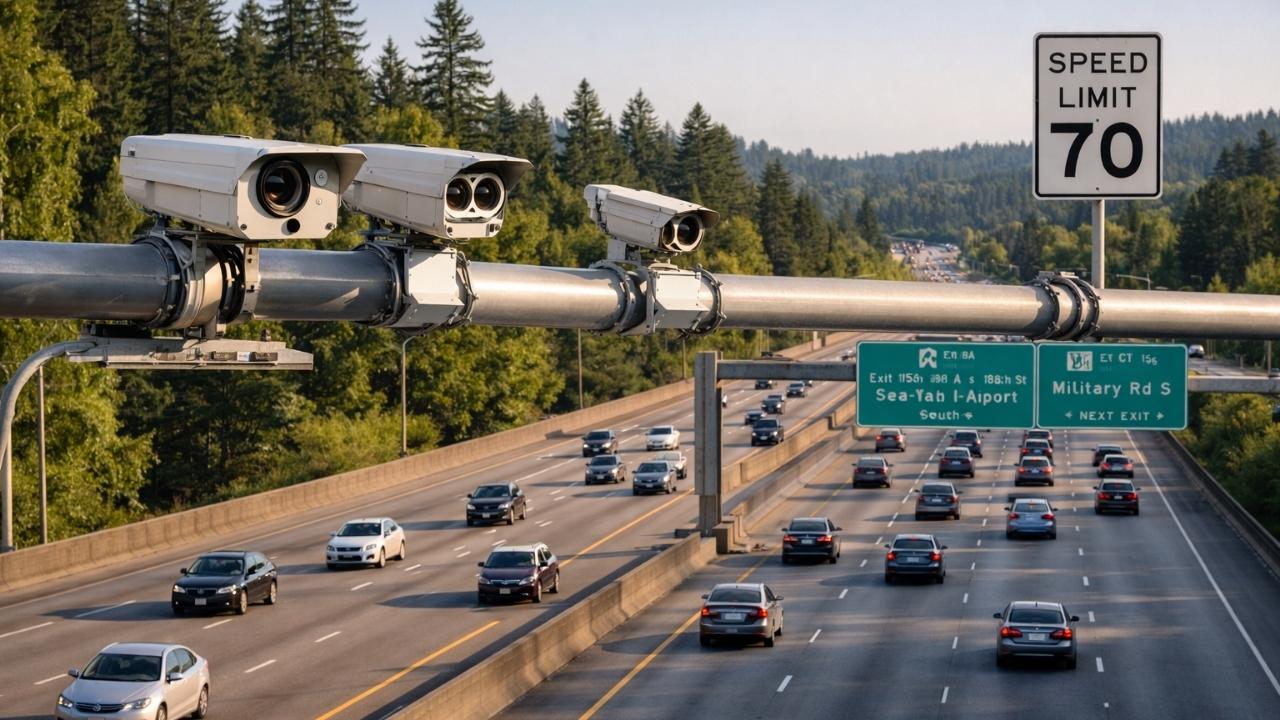
Across the United States, more than 70% of police departments now rely on automated vehicle-monitoring technology, and license plate readers can scan thousands of vehicles per hour. At the same time, public concern about digital privacy and data retention has grown steadily, especially as traffic enforcement increasingly relies on technology rather than officer-led enforcement.
Washington State has responded to this shift by proposing new limits on the collection and use of vehicle data. The change reflects a growing effort to modernize traffic policy while balancing road safety, civil rights, and transparency for everyday drivers.
Table of Contents
Constant Evolution of Driving Regulations

Traffic laws in the United States are not static. As vehicles become more technologically advanced and cities grow more complex, state governments frequently revise their rules to address safety, efficiency, and accountability.
Recent examples highlight how quickly these changes can occur:
- New York has updated its violation point system to reflect modern enforcement priorities.
- Iowa has strengthened enforcement of hands-free driving laws to reduce distracted driving.
- Effective May 2025, the REAL ID requirement will alter the use of driver’s licenses for domestic air travel and access to federal facilities.
These updates demonstrate that drivers must remain attentive not only to how they drive but also to how regulations shape their daily travel experience.
Washington’s New Focus on License Plate Reader Technology
Washington’s latest legislative action does not directly target driving behavior. Instead, it concentrates on the tools used to observe and record vehicles.
The proposal addresses Automatic License Plate Reader (ALPR) systems, capable of scanning thousands of plates per hour and storing the information for later use. Until now, these systems have operated with relatively broad authority and limited public understanding of how the data is collected or shared.
Under the new framework, ALPR use would be restricted to specific and clearly defined purposes. Law enforcement agencies would be permitted to use the technology for serious matters such as locating stolen vehicles, assisting in searches for missing or endangered individuals, and investigating felony-level crimes. Parking enforcement departments could continue using the systems to track time limits or identify vehicles subject to impound. Toll collection and traffic flow analysis would also remain allowed uses.
Rather than eliminating the technology, the legislation narrows its scope and establishes boundaries on when and why it can be activated.
Limits on Surveillance and Data Collection
Equally important are the restrictions placed on what ALPR systems cannot be used for. The bill would prohibit the use of these cameras for immigration enforcement or to monitor lawful demonstrations and free speech events.
Additionally, the collection of license plate data would be prohibited near sensitive locations such as schools, hospitals, courthouses, places of worship, and food assistance centers. The purpose of these safeguards is to minimize the potential for misuse and guarantee the absence of unnecessary digital tracking in essential community spaces.
The intent is not to weaken public safety but to introduce stronger oversight and ethical standards into the operation of automated surveillance tools.
Why Traffic Camera Policy Remains Controversial
Automated monitoring technology has long divided public opinion. Advocates argue that cameras increase efficiency, deter crime, and support traffic safety initiatives. However, critics voice concerns about personal privacy, long-term data storage, and the potential misuse of information beyond its intended purpose.
Washington’s plan tries to find a middle ground between these two points of view. It recognizes the value of modern technology while also acknowledging that unchecked monitoring can erode public trust. By defining acceptable uses and excluding others, the state aims to restore clarity and accountability to how these systems function.
What This Means for Drivers in Washington
For regular drivers, the end result may be a system that is easier to understand and has fewer unknowns. Instead of wondering when or why their movements are being recorded, motorists can expect clearer rules governing camera use and stricter limits on data collection.
This approach reflects a broader understanding that safety and privacy need not be in opposition. With defined boundaries in place, Washington drivers may experience a future where technology supports road safety without creating a constant sense of surveillance.
A Step Toward Balanced Enforcement
Washington’s decision to regulate license plate reader cameras represents more than a technical adjustment. It signals a shift in philosophy, one that seeks equilibrium between public safety, technological progress, and individual privacy.
While the cameras will remain part of the transportation system, their role will be more focused and restrained. For many drivers, this change offers reassurance that the road ahead may involve fewer intrusive monitoring practices and clearer expectations about how data is used. In this sense, Washington is not removing oversight but redefining it with greater care and responsibility.