
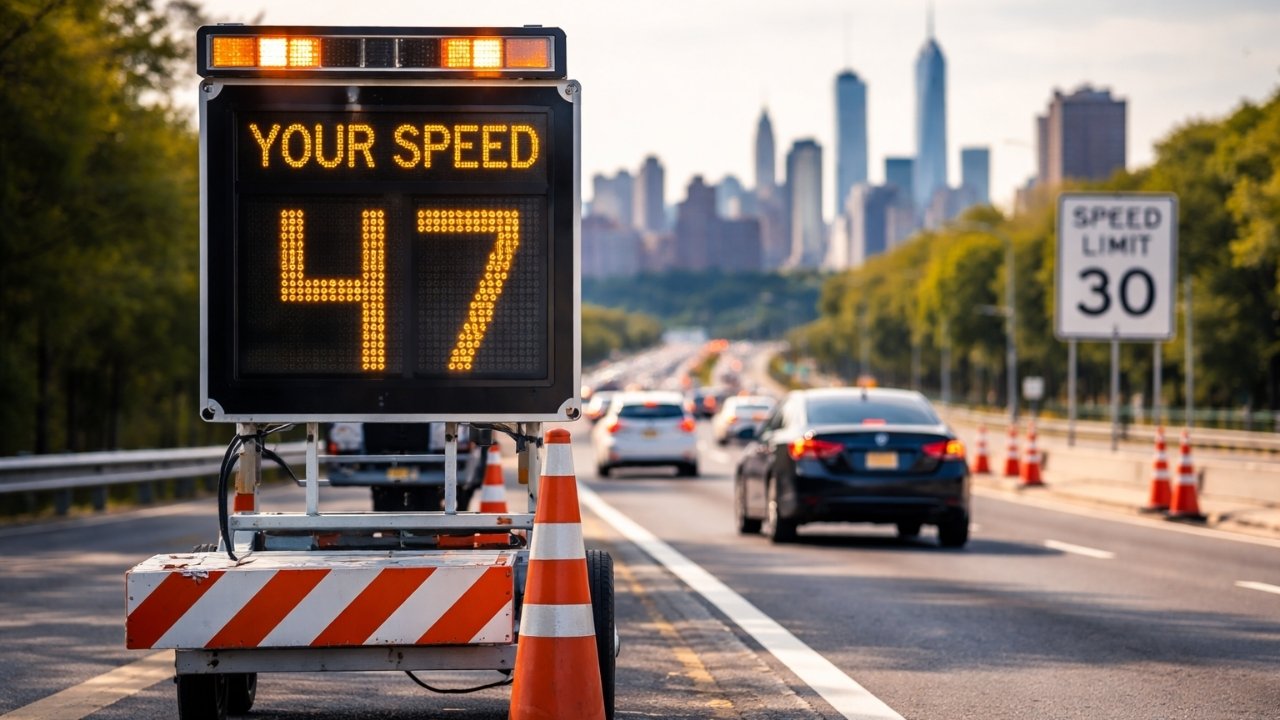
New York State’s driver-penalty system will change in February 2026, and the final weeks before implementation are important for everyday motorists. The update focuses on how many DMV points are assigned for common violations and how quickly drivers can reach a level that may trigger suspension review.
The reason this change is often described as a “1 mph” issue is simple. In New York, a speeding ticket can be issued for driving even slightly above the posted limit. At the same time, the lowest speeding bracket (1–10 mph over the limit) is set to carry more points, which increases the impact of small-speed tickets when combined with other violations.

These changes matter because points can lead to two major outcomes: DMV enforcement action and additional costs, such as state assessment fees and potential insurance premium increases depending on the driver’s record and insurer rules.
Table of Contents
Changes Starting from February 2026
The new framework introduces both a point-value update and a threshold update. Several violations will carry higher point values, and the period during which points are counted together will become longer.
This means a driver who receives tickets months apart may still see them added together when the DMV reviews the record for possible suspension action.
Threshold and time window comparison
| Item | Current system | Planned system (Feb 2026) |
|---|---|---|
| Point total triggering suspension review | 11 points | 10 points |
| Time window used | 18 months | 24 months |
| Reference date for counting | Date of violation | Date of violation (expected to continue) |
Meaning of the “1 mph” rule

The phrase “1 mph” does not create a new offense category. It reflects that any speed over the limit can be cited as speeding. Under the updated framework, the 1–10 mph over-limit category will increase in point value.
This change is important because small speeding tickets, which many drivers consider minor, will now contribute more strongly toward reaching the suspension threshold when combined with other violations such as phone use or failure to yield.
Violations with higher point values
| Violation | Current points | Planned points (Feb 2026) |
|---|---|---|
| Speeding 1–10 mph over limit | 3 | 4 |
| Cell phone use while driving | 5 | 6 |
| Reckless driving | 5 | 8 |
| Passing a stopped school bus | 5 | 8 |
| Failure to yield to pedestrians | Commonly lower | 5 |
New points for minor violations
Some violations that previously carried no points will now add to a driver’s total. This is significant because even one or two points can matter under the new 10-point threshold over 24 months.

Equipment issues and certain traffic movement errors will no longer be treated only as fine-based offenses. Instead, they will count toward the driver’s point history, increasing the chance of reaching enforcement levels sooner.
Construction zones and strict penalties
Construction zones receive special attention in the updated system. Speeding in these zones is set to result in 8 points regardless of how many miles per hour over the limit the driver was traveling.
This makes construction zones one of the highest-risk areas for accumulating points. A single violation in such a zone can bring a driver close to the suspension threshold even without other serious offenses.
Rules drivers should remember
Points are added only after a conviction, but the time window is measured from the violation date, not the court decision date. This means a ticket resolved later can still fall within the point-counting period.
Even when points no longer count toward DMV suspension calculations after the time window ends, the conviction itself can remain on a driving record and may still influence insurance premiums depending on the insurer’s policies.
Final days risk reduction steps
- Obey posted limits exactly in construction zones and near schools.
- Avoid handheld phone use and minimize in-car distractions.
- Check basic vehicle equipment such as lights and plates.
- Follow school bus stopping rules without exception.
- Identify routes with frequent construction zones or speed changes.
- Assume recent tickets will remain relevant longer after February 2026.
- Remove avoidable violations such as phone handling and unsafe turns.
- Use point-reduction or safety courses where legally available and applicable.
Overall impact on drivers
The February 2026 update means that points will carry greater weight and remain relevant for a longer period. A lower suspension-review threshold combined with higher point values for common violations makes it easier for ordinary drivers to reach enforcement limits.
The focus on the “1 mph” issue reflects the reality that even small speeding tickets will now have a stronger effect on a driver’s record. In the final days before the change takes effect, reducing exposure to high-point categories, especially construction-zone speeding, phone use, reckless driving, and school bus violations, offers the most direct way to avoid future penalties under the new system.